The Testing Challenge Behind eVTOL Programs

eVTOL programs operate under compounding pressure. Certification frameworks are rapidly evolving, often adapted case by case, while teams must simultaneously mature electric and hybrid propulsion, battery integration, high-reliability sensors, and autonomous flight.

Capital runs fast before revenue exists, which makes every investment in test infrastructure a consequential decision. And the end target is unforgiving: production at single-aisle scale, with strict SWaP constraints and reliance on infrastructure that doesn't fully exist yet.

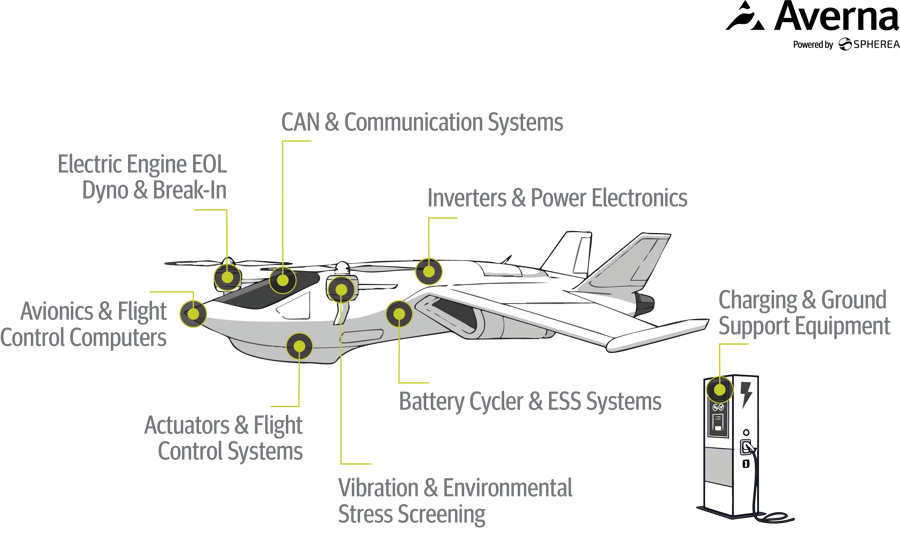
Averna covers the full eVTOL development cycle, from prototyping through production. Despite the diversity of aircraft designs, underlying system architectures and certification constraints remain largely comparable across vehicles, which allows test platforms commonality for faster deployment across programs. eVTOL sits at the intersection of two engineering domains that Averna has been serving for years: aeronautical critical systems and electrified powertrain validation.

This combination allows us to address new eVTOL technologies leveraging pre-existing and proven solutions.
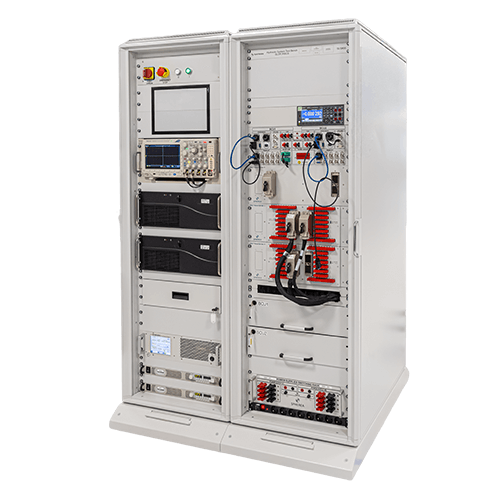
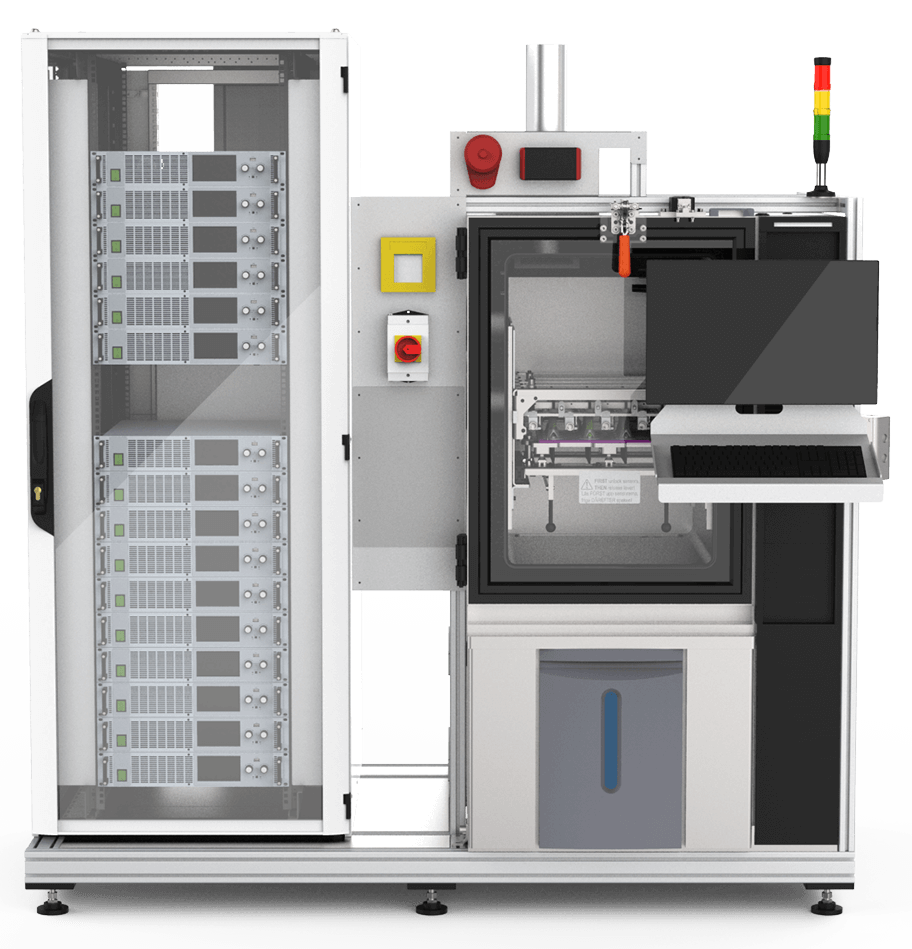
How Averna Approaches eVTOL Testing

Averna's approach is built on one principle: test assets developed early in a program should remain usable through final qualification and into production, adapting to the program as specifications and certification requirements evolve. 

  1. Rapid Embedded Prototyping

    Averna enables fast deployment of onboard functions through prototyping platforms compatible with model-based design. Engineering teams can assess system performance and iterate quickly. This short feedback loop enables timely validation of technical choices and reduces the need for late-stage corrections. 
  2. Early Validation in Development

    Testing starts at the earliest stages of system design. Critical functions are evaluated even in partial or evolving configurations. Identifying issues early prevents downstream impacts and supports more robust architectural decisions.  
  3. Iterative and System-Level Validation

    Rather than validating isolated components, Averna focuses on system-level behavior from the start. Test environments are continuously adapted as requirements evolve, allowing teams to capture complex interactions between subsystems while maintaining a fast iteration cycle. 
  4. Certification-Driven Testing Approach

    eVTOL programs evolve within frameworks such as EASA SC‑VTOL and FAA Special Class certification under 14 CFR §21.17(b), where airworthiness requirements and certification approaches are still maturing and are tailored to each aircraft. Averna aligns testing activities with these certification requirements early, ensuring that validation work feeds directly into compliance expectations and reduces gaps between engineering and regulatory evidence.  

Discuss Your Program With Our Experts

Ready to align your test strategy with your program timeline? Talk to an eVTOL test engineer about your current development phase. 

Discuss Your Test Requirements

System Integration & HIL Platforms

Averna deploys unified test environments covering MIL, SIL, PIL, and HIL configurations on a single platform. Real-time simulation is combined with physical equipment, and the architecture remains open to third-party tools and COTS components. Multi-domain support spans:

  • Avionics
  • Electrical and propulsion systems
  • Actuation systems
  • Embedded software with modular, distributable hardware that scales as the program matures

Power & Energy Validation

Electric and hybrid powertrains require high-fidelity emulation across the full energy chain. Averna's systems support motor, battery, and fuel cell emulation alongside converter testing (AC/DC, DC/DC, AC/AC) and power electronics validation for inverters and choppers.

Platforms scale from tens of kilowatts to several megawatts, covering both subsystem validation and full powertrain integration.

End-of-Line Production Testing

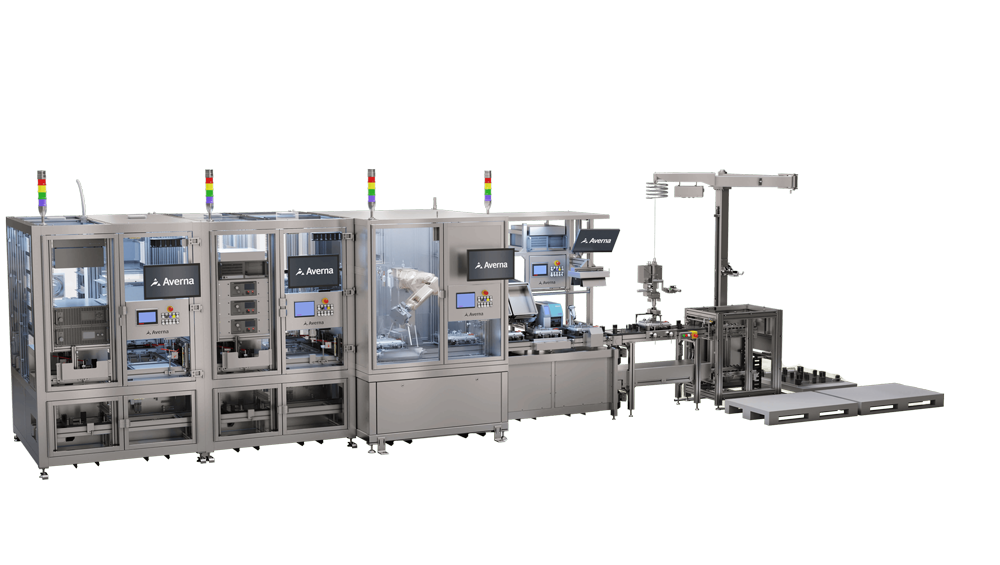
Averna's EOL testing solutions cover the critical assemblies that must be verified at production rate:

Critical Assemblies
Battery packs
High-voltage EOL stations with high channel counts, instrument virtualization, critical scenario simulation, climate control, multi-protocol communication 
EV inverters and power electronics
Insulation, high-voltage AC, infrared testing, leak testing (cooling circuits, housing, connectors) and automated optical inspection (AOI) with 3D pin inspection, traceability and quality validation 
EV chargers
Battery simulation, multi-standard charge support (CCS1, CCS2, NACS), real-time monitoring, high-power testing beyond 600 kW, automated conformance testing 
Actuators
Electromechanical and hydraulic validation with dynamic load application, real-time architecture, high-precision tooling, tight-tolerance fixturing, FEA-validated load paths 

Digital Test & Manufacturing

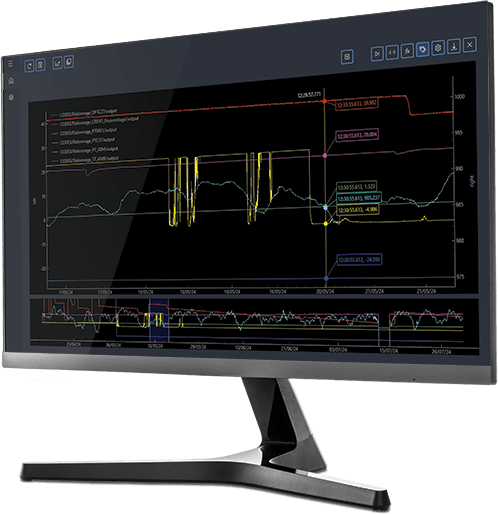
Averna centralizes smart test management across programs and sites, with full digitalization from requirements to execution. Distributed I/O modules support both production-line deployment and field diagnostic use cases. Data is structured to ensure traceability and integration within digital engineering environments.

Case Study

In-Line Validation for Electric Motors

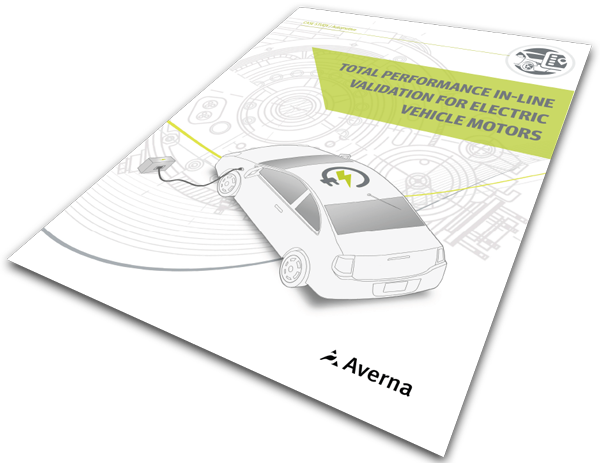
Cover - Total Performance In-Line Validation for Electric Vehicle Motors

Averna developed a fully automated end-of-line validation system to ensure performance and quality of electric motors throughout the assembly process.

Key takeaways

  • Fully automated test line reducing inspection time from 45 minutes to 5 minutes while improving measurement accuracy
  • Multi-stage validation combining high-voltage, vibration, and performance testing to detect issues early and ensure system-level reliability

This approach minimizes risk before products reach the field and supports consistent product quality at scale. It also demonstrates how integrated validation can accelerate industrial readiness for complex electrified systems such as eVTOL.

Ready to Build Your eVTOL Test Strategy?

Discuss your program phase and system architecture with our eVTOL test engineers.