What is End-of-Line Testing

End-of-Line (EOL) testing is the final stage of the manufacturing process where a finished product is tested under functional conditions to ensure it meets all performance and quality specifications.

EOL testing verifies that the product meets its functional specifications. Unlike in-process testing, it focuses on the complete, assembled unit, which also distinguishes it from the testing of individual components.

Because EOL is the final gateway before shipment, it is also the point where missing defects carry the highest cost: warranty claims, field failures, and potential recalls or compliance exposure. A well-designed EOL test station reduces that risk without becoming a bottleneck on the line.


How Averna Approaches EOL Testing

EOL testing is the last stop, but not the whole story. Averna works across the complete product lifecycle, helping you reduce quality costs at every stage, not just the final one. With that in mind, EOL remains a critical step in its own right. Here is how we approach it.

  1. Easily Customizable Test System Design

    Averna's EOL test systems are built to adapt to your line and your volume. We design hardware and software that fit your constraints. Our platforms are compatible with a wide range of test instruments and interfaces, so you're never locked into a single architecture.

  2. Compliance and Quality Parameters

    Every industry comes with its own set of requirements, and we already know them. Averna designs EOL systems for your needs that meet the compliance standards your product is held to. Our solutions are built to verify operational capability while capturing the data and audit trails that regulators and quality teams expect.

  3. Data Recording for Better Insights

    Our platforms are designed to record the DUT ID, DUT location, time, timestamp, and all test results, for traceability purposes, but also to accelerate the handling of returns: when a unit comes back to the bench, its original test data is already there.

Applications where EOL Testing is Applied

End-of-line testing is carried out across all industries, as it is an essential part of the quality control process. Below, you can see the main applications.

Icon - Automotive and Transportation

Automotive

EOL tests often include CAN/LIN communication verification and end-of-line calibration writes among other functional tests for ECUs, inverters, ADAS modules, battery packs, EVSE, and electromechanical assemblies.

Icon - Consumer Electronics

Consumer Electronics

Smartphones, wearables, and home appliances. High-volume lines demand test times measured in seconds. Parallel testing and fast measurement hardware are standard.

Icon - Life sciences

Medical Devices

Infusion pumps, imaging modules, diagnostic equipment. EOL tests must satisfy IEC 62304 and 21 CFR Part 11 requirements.

Icon-Robotics & Motion

Industrial Equipment

Drives, sensors, power supplies, and control systems. Tests often combine electrical characterization with mechanical or thermal stress to simulate in-field conditions.

Icone-Aerospace and Def

Aerospace & Defense

Avionics, radar components, and communication systems. Lower volumes, stricter tolerances, and accommodation to evolving standards like MIL-STD, DO-254, FAA/EASA and DO-160.

Icon - Automotive (EV)

Energy & EV Charging

Charging units, grid-edge hardware, and battery management systems. EOL tests verify safety-critical protection circuits and calibrate measurement accuracy before deployment.

Talk to a Test Engineer

Tell us about your application and production volume, and we’ll help define a realistic and scalable test architecture. 

Discuss Your Test Requirements

Technical Capabilities for End-of-Line Testing

Every unit that leaves your line carries your brand. Our EOL test designs focus on one requirement: nothing ships unless it passes. A single automated EOL sequence can compress an entire validation workflow into a single automated sequence: functional testing, safety checks, leak testing, pressure testing, load performance, software, visual inspection, and more.  

Custom EOL Test Platforms

Every Averna station is designed for clarity and long-term serviceability: intuitive HMIs, unambiguous pass/fail labeling, and modular fixtures that adapt to product variants without requiring a full redesign. Maintainability is never an afterthought: our platforms are architected so your team can troubleshoot and scale without depending on us for every change. See it in action: our EOL test station developed for EV power component validation is one example of what purpose-built looks like at production scale.

Some EOL testing key metrics:

Definition
Operational Impact
First Pass Yield (FPY)

Ratio of conforming units on the first pass, without rework

Primary KPI for production line efficiency

Test Coverage

% of functional specifications validated by the test bench

Insufficient coverage leads to field failures and escapes

Cycle Time

Total test duration per unit

Directly tied to line throughput

False Failure Rate

Rejection rate caused by over-specified test limits

Penalizes FPY with no real quality benefit

High Speed Vision Systems for End-of-Line Quality Management

Our high-speed vision systems can process up to 1,800 parts per minute, flagging dimensional deviations, surface defects, assembly errors, and labeling non-conformances that would escape manual review entirely. Real-time 2D and 3D inspection platforms operate down to the submicron scale, with line-scan and laser-profiling capabilities reaching resolutions as fine as 1.5 μm.

Optical Character Recognition, Optical Character Verification (OCR/OCV) and barcode verification are natively integrated, ensuring correct serial numbers, logos, and traceability codes are present and readable on every unit before it leaves the line. AI-driven analytics detect micro-defects and deviations in milliseconds.

Automated Systems 

At Averna, robotic integration is a tailored engineering process. Our mechatronics engineers design precision fixtures, and fully synchronized motion sequences that accommodate repositioning units across multi-step test cycles.

We deploy robots from trusted vendors including Mecademic, FANUC, Stäubli, and Epson, integrating them seamlessly with vision systems, test benches, and motion control platforms. Positioning accuracy reaches ±2 μm, making our automated test solutions suitable for the most demanding EOL applications.

Case Study

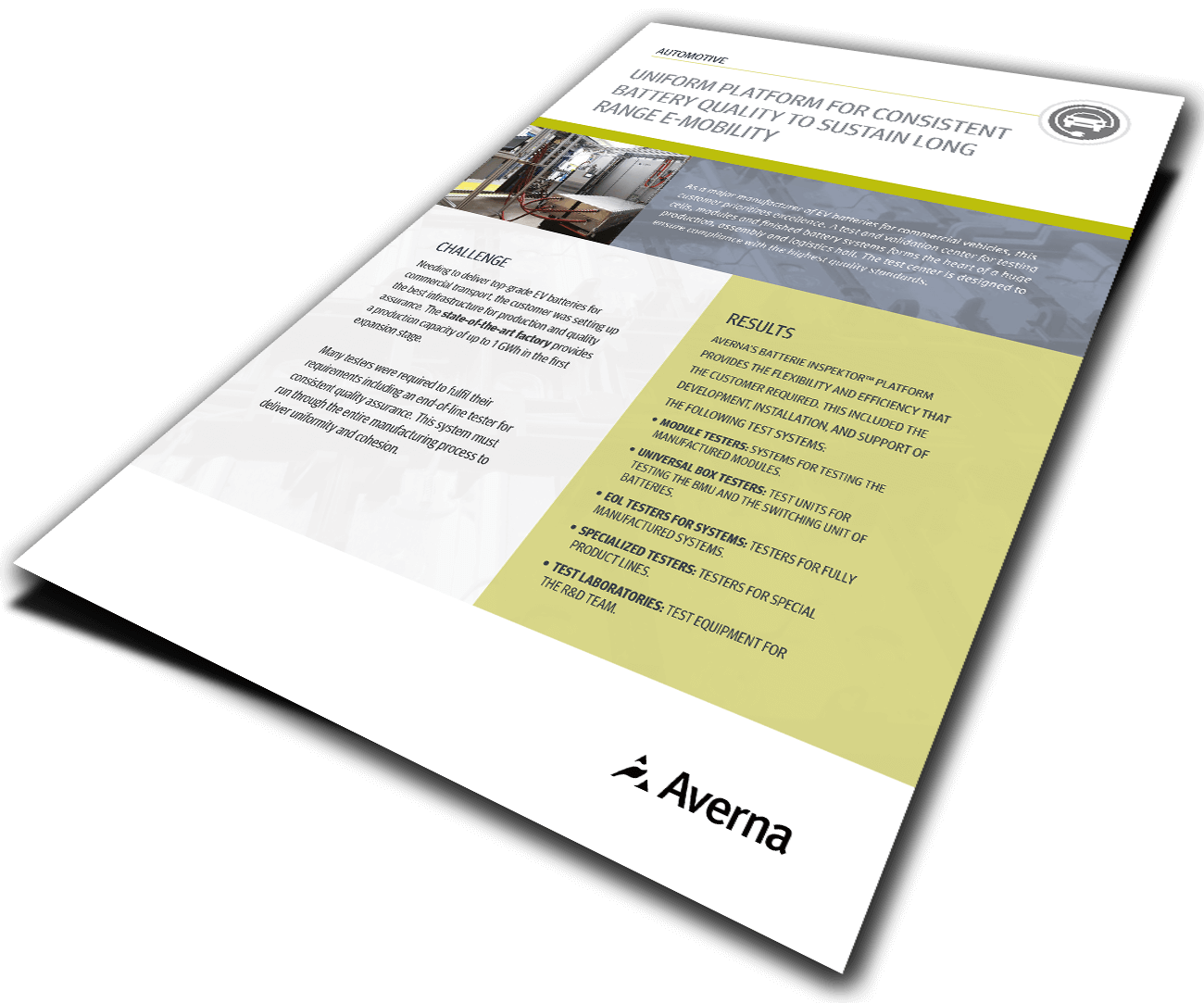
Standardizing EOL Testing across Battery Production

Cover - Uniform Platform for Consistent Battery Quality to Sustain Long Range E-Mobility

In a high‑volume EV battery production environment (up to 1 GWh capacity), the manufacturer needed a consistent end‑of‑line testing approach to validate full battery systems and ensure uniform quality across the entire production flow.

Key Takeaways:

  • Batterie Inspektor™ enables end‑of‑line testing of complete battery systems within a shared framework also used for cells and modules
  • The platform integrates with enterprise systems (SAP, databases, QA formats) and supports IoT readiness

End‑of‑line testing becomes a structuring layer of battery quality, validating system performance under real conditions while aligning seamlessly with a connected, standardized production ecosystem.

up to 1 GWh Production capacity

Your Production Line, Our Expertise

With 25,000+ test and quality projects delivered across automotive, consumer electronics, life sciences, and beyond, Averna’s engineers know what a production line demands, that is why we build EOL systems that meet it without compromise.