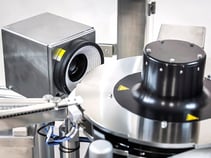
Automated Seal Inspection to Prevent Defects

In high-stakes manufacturing, the margin for error in seal integrity is non-existent. Our leak testing solutions represent the pinnacle of automated quality control, integrating highFlaws found in package seals are a significant source of Corrective and Preventive Actions (CAPA) for medical contract manufacturers, and this issue extends well beyond regulated environments.

A compromised seal such as a channel leak or an incomplete bond is often invisible to the naked eye. Contamination trapped in the seal plane or subtle process deviations can remain undetected until product performance is affected or sterility is compromised. By that point, the impact in recalls, investigations, and production disruption is significantly higher than detecting the issue inline.
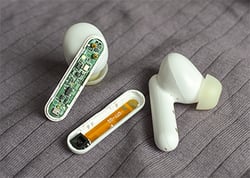
Manual inspection struggles to reliably detect micro-defects, while traditional inspection systems often generate false rejects that reduce efficiency and confidence in the process. At the same time, regulated industries must ensure that inspection is not only accurate, but also validated and traceable at the unit level.

Averna designs automated seal inspection systems that address all these challenges by combining high-resolution imaging with adaptive inspection strategies and real-time analysis.  

Our systems are designed to detect critical defects such as channel leaks, incomplete seals, seal width deviations, folds, wrinkles, foreign material entrapment, and micro-punctures across applications including: 

  • blister packs 
  • flexible pouches such as Tyvek-based sterile barriers 
  • rigid packaging formats 
  • sealed electronic enclosures requiring high levels of integrity
How Averna Approaches a Seal Inspection Project

Every engagement starts with a qualification phase. No two products and their production lines behave the same, and seal inspection performance depends on how well the system is aligned with real process conditions. 

  1. Phase 01

    Requirements & Defect Taxonomy

    We document the full defect catalog and align on accept/reject criteria with your quality and regulatory teams. This will be based on actual results achieved during the qualification phase and discussed at a verry early stage to have full alignment on the system inspection capabilities and validation criteria upfront. 
  2. Phase 02

    System Design & Golden Sample Library

    We engineer the imaging setup together with automatic product handling and build a labeled dataset of golden samples and defect specimens to train or configure the detection algorithms. This makes offline programming, (re)-training and validation possible.
  3. Phase 03

    Integration, FAT, SAT, IQ/OQ/PQ Validation

    The system is integrated into your line, then formally validated on the upfront agreed acceptance and validation criteria during the FAT & SAT. After acceptance we can go even further with support during Installation, Operational, and Performance Qualification — with full documentation for regulatory submission. This documentation can be aligned with specific quality management procedures. 
  4. Phase 04

    Production Monitoring & Continuous Improvement

    Post-deployment, we provide SPC dashboards, alarm management, and periodic requalification to maintain detection performance as your product evolves. Additionally, our BCS (Business Continuity Services) team can provide SLA’s, preventive maintenance and support services to keep the equipment in the best condition possible. 

Industries We Serve

Seal integrity requirements vary significantly across sectors. Averna has deployed systems across primary regulated verticals, each with distinct compliance and throughput demands.

MedTech Devices

Inspection of sterile barrier systems, including Tyvek seals and dimensional verification of seal width. Systems detect folds, wrinkles, and particulate inclusions, with full validation support (IQ/OQ/PQ), per-unit traceability, and support meeting compliance with ISO 11607 and FDA 21 CFR Part 11.

Pharmaceutical Packaging & Nutraceuticals

Blister pack and bottle cap seal verification with serialization integration. For pharmaceutical applications, systems can be configured to support GMP computerized-system requirements such as EU Annex 11 and 21 CFR Part 11, where applicable. Traceability is aligned with serialization, aggregation, and product-tracking workflows.

Consumer Electronics & Waterproof Devices

Inspection of sealed enclosures, adhesives, and gaskets for IP-rated products. Systems are optimized for high-throughput environments and can maintain short cycle times under 500ms with near-zero false reject rates.

Aerospace & Defense

Hermetic seal inspection for connectors, housings, and enclosures used in harsh environments. Systems provide full audit traceability aligned with MIL-STD and AS9100D requirements, with support models adapted to long program lifecycles.

Custom Seal Inspection Solutions for your Application

Consult with an engineer on your specific leak limits.

Ask us about Seal Inspection

Advanced Technologies & Capabilities for Seal Inspection Integrity 

Modern automated seal inspection combines multiple sensing modalities (2D machine vision, 3D profilometry, and, where required, non‑destructive pressure or vacuum‑based leak testing) depending on the defect types of concern and the throughput required.

At its core, the system acquires an image or measurement of each seal, extracts features (geometry, intensity gradients, surface topology), and compares them against validated acceptance criteria derived from a golden image set and statistical process control limits.

Precision Assembly EquipmentWhere appropriate, machine learning classifiers, typically CNNs for image-based defects, are selectively used to handle the variability of real production environments, where lighting drifts, substrate variation, and material lot-to-lot changes would otherwise require constant threshold retuning of traditional vision algorithms.
For applications requiring enhanced leak localization or robustness to sealing variability, Averna can combine pressurized gas methods with controlled illumination and vision algorithms. This enables precise detection and localization of leaks, supports non-destructive testing, and improves defect analysis in complex or variable sealing conditions.

Defect Types Seal Inspection Systems Detect

Detection capability is defined at the requirements phase and validated against a characterized defect library. Common defect categories for seal inspection include:

  • channel leaks and seal discontinuities
  • incomplete seals and adhesion failures
  • seal width variations outside defined tolerances
  • wrinkle or fold defects that compromise barrier integrity
  • particulate inclusions (particles, fibers, hair) trapped in the seal plane
  • punctures, scratches, creases, and slanted cuts affecting sterile barriers

For hermetic seals in aerospace and implantable devices, we also qualify leak-rate testing via pressure-decay and mass-flow methods, integrated as a secondary station downstream of the vision system.

Adaptive Inspection with Machine Learning

Rule-based systems work well for controlled, well-characterized defect types on stable production lines — they're deterministic, easy to validate, and require no training data. Therefore they are often preferred in regulated environments because they are easier to explain, verify, and maintain under change control.
CNN-based classifiers excel when defects are morphologically variable, when substrate appearance changes between product lots, or when the defect taxonomy evolves over time. Averna's approach is hybrid: rule-based thresholds gate pass/fail on dimensional compliance, while a classifier handles texture- and appearance-based anomaly detection where rules would require constant manual adjustment. 

Validated for Production (IQ / OQ / PQ)

For regulated industries, validation is a prerequisite for production use. Factory Acceptance Testing (FAT) and Site Acceptance Testing (SAT) are performed as part of system delivery and approval.

Following SAT approval, Averna can support customers in preparing the documentation needed for their IQ/OQ/PQ activities, which will be executed within the customer’s own quality management framework.

Depending on the project, FAT and SAT documentation may be reused as input to the validation process. Averna can also provide additional documentation and technical support on request. 

Vision algorithms, illumination settings, and acceptance thresholds are version-controlled, documented, and verified to support audit readiness and long-term system stability. 

Case Study

Inline Flexible Pouch & Seal Inspection for a MedTech Manufacturer

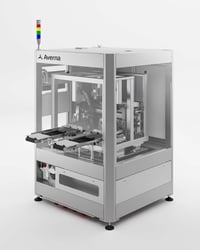
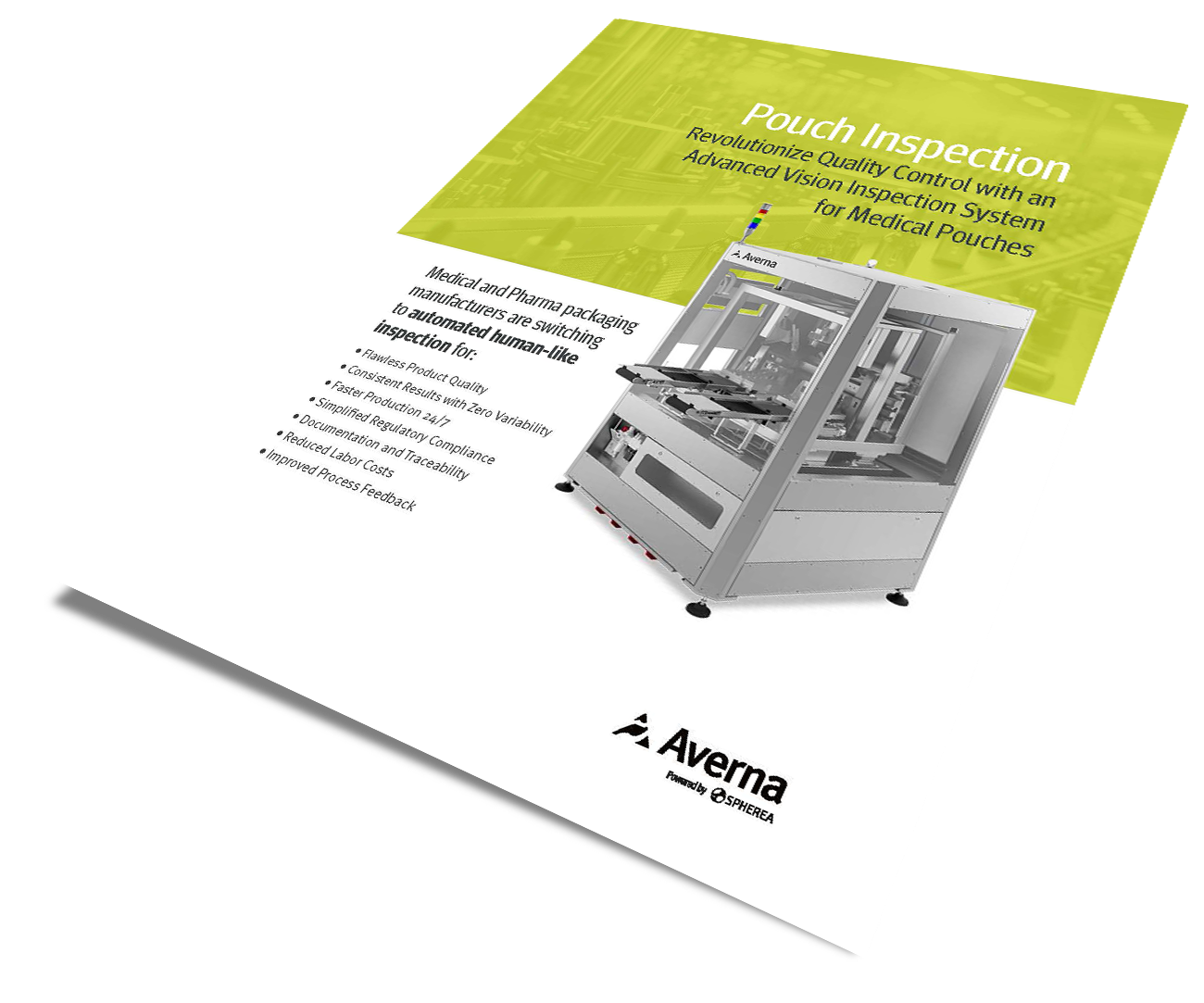
Pouch Inspection System

A European MedTech manufacturer required reliable inline inspection of flexible pouches to ensure seal integrity, sterility barrier performance, and correct package content.

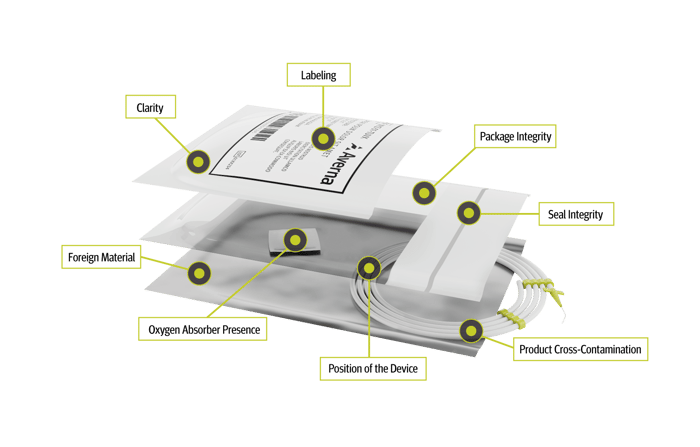
Averna delivered multiple vision‑based inspection platforms enabling top, bottom, and content presence inspection, with detection of ≥20 µm defects on Tyvek seals, contamination, labeling issues, and device positioning. The inspection platform verifies all critical packaging attributes, including: 

  • Tyvek seal integrity (overlaps, folds, wrinkles, seal width)
  • Sterility barrier defects (punctures, scratches, folds, creases)
  • Detection of foreign materials such as particles, fibers, hair, or grease

The solution was integrated inline at a ~10‑second takt time and deployed across multiple test stations to support consistent, repeatable quality control in production.

Ready to Eliminate Seal Defect Escapes?

Discuss your application with our experts and validate the right seal inspection strategy.