Delivering consistent performance in immersive devices requires more than isolated calibration steps. EXtended reality testing in a manufacturing context demands integrated optical measurement systems, motion-controlled sensor calibration, embedded subsystem validation, and controlled environments engineered for repeatability.
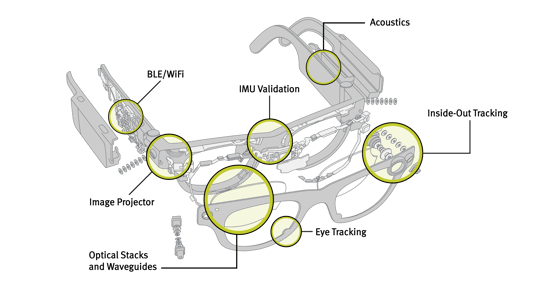
AR/VR devices combine optics, sensing, electronics, and connectivity within a tightly integrated system. The diagram below illustrates the scope of Averna's AR/VR testing coverage across these subsystems.
Optical Measurement Architecture
Near-eye display performance directly impacts perceived sharpness and alignment. In production, these parameters must be measured under controlled conditions and with defined tolerances.
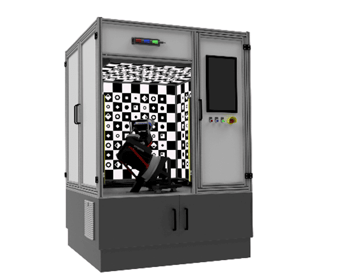
Averna's AR/VR testing systems use precision optical benches with fixed capture geometry and mechanically constrained positioning. This removes operator influence and ensures deterministic alignment between the device under test and the measurement system.
Image quality is evaluated using objective methods such as MTF analysis and distortion mapping. Field-of-view is validated against defined specifications using calibrated optical references and controlled illumination. Display timing and refresh rate validation can also be incorporated to ensure consistent visual performance across operating modes.
For applications requiring high optical precision, active alignment workflows can be integrated to dynamically adjust and validate component positioning during assembly.
The result is a measurement architecture designed for repeatability. The same device tested during engineering validation can be characterized using equivalent methods on the production floor, without redefining the measurement strategy.
Sensor and Motion Calibration
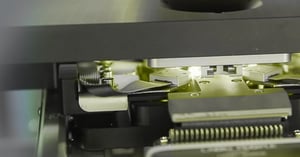 Averna integrates multi-axis linear and rotational stages capable of reproducing controlled motion trajectories within tightly defined tolerances. These platforms enable:
The system is not limited to static calibration. It also supports controlled motion validation, allowing manufacturers to observe sensor behavior during dynamic sequences rather than relying solely on fixed-point measurements. In production, this architecture enables structured functional verification of motion subsystems.
The result is a calibrated and functionally validated motion stack that meets manufacturing requirements without introducing unnecessary complexity to the production flow.
Measurement Integrity and Production Control
AR/VR testing is only valuable if measurements remain stable over time. Repeatability and traceability determine whether a platform can move from engineering builds to sustained production.
Each test station is designed with controlled DUT loading and mechanical constraints that prevent movement once the device is secured. This reduces positional variability at the source rather than compensating for it in software.
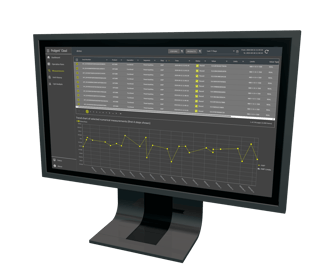
Before release to the factory floor, repeatability analyses are performed and GR&R studies are executed to quantify measurement variation. The objective is to confirm that the system can distinguish between true product variation and measurement noise. Environmental factors such as temperature shifts, vibration exposure, and long-duration drift are evaluated to ensure calibration stability under realistic operating conditions.
Measurement results are captured at the source and structured for integration into MES environments. This enables statistical process control, yield tracking, and consistent comparison between lines and sites during NPI ramp-up and high-volume production.
Hardware and Software Integration for AR/VR Testing
Averna develops complete test ecosystems that integrate mechanical fixturing, motion control, vision systems, RF Testing and custom electronics with industrial software frameworks designed for factory deployment.
At the hardware level, systems interface directly with the device under test through custom communication interfaces supporting PCB assemblies, programmable power control, and high-speed data acquisition. Deterministic triggering ensures synchronized interaction with cameras, IMUs, displays, RF modules, and embedded electronics during calibration and functional verification. Power stability and embedded subsystem response can be validated as part of structured end-of-line testing.
At the software level, Averna Launch, a centralized test executive manages sequencing, firmware interaction, and calibration routines while processing measurement data in real time. Results are logged in structured formats to support MES connectivity and long-term traceability. Integrated computer vision tools may also be deployed for feature detection, alignment verification, or defect identification where required.